



Sweden
A long, thin country that runs from the design cafes of Stockholm to Arctic Lapland, where the summer sun never quite sets and the winter sky burns green. Sweden rewards travelers who pick a season, commit to it, and let the endless summer light or the northern lights set the itinerary.
Sweden splits in two by season. Give it 10 days to two weeks, choose summer light or winter aurora, and don’t try to cover Stockholm and Lapland in one short trip.
Pack Lightly editorial team
At a glance
- Top-tier logistics and vast wilderness. Sweden scores 95 for tourist infrastructure and 90 for nature, one of the easiest wild places in Europe to travel.
- Budget around $65 a day backpacking, $155 mid-range. Sweden is expensive, on par with Norway and Denmark, and drinks and eating out are the sharpest lines.
- Summer (June to August) brings near-endless daylight and mild days. Winter is for Lapland: the northern lights, dog-sledding and the Icehotel.
- Ten days covers Stockholm, the archipelago and a southern city or two. Two weeks reaches Lapland and the Arctic north.
- The catch: prices bite and the seasons are extreme. Summer daylight barely quits, while December gives Stockholm about six hours of light and the far north almost none.
Everything to know before you book
The essentials for a Sweden trip: entry rules, money, the climate window and power, in one scan.
What Sweden does best, and where it doesn’t
Ten categories scored 0 to 100 from tourism data, traveler reports and on-the-ground experience.
Sweden is a rare mix of effortless logistics and genuine wilderness. Trains run on time, the cities are walkable, and the Arctic north is as wild as Europe gets.
Costs run high, among the steepest in Europe once you add drinks and restaurants. Swedes are helpful and speak flawless English, though the reserve takes a little warming up.
Best places to visit in Sweden
Twelve destinations that anchor most trips. Filter by region to plan your route.
Stockholm
Fourteen islands of stately waterfront, the medieval lanes of Gamla Stan, and world-class design and museums, with the archipelago waiting on its doorstep.Gothenburg
The laid-back second city: seafood straight off the boat, canal-side cafes, and the ferry gateway to a rugged island coast.Malmo
A short hop from Copenhagen over the Oresund Bridge, with the twisting Turning Torso, a multicultural food scene, and bikes everywhere.Kiruna
Sweden’s northernmost town, home of the original Icehotel and the launch point for aurora nights and Sami culture above the Arctic Circle.Abisko
The most reliable northern-lights window in Sweden thanks to a rain-shadow sky, plus the start of the Kungsleden trail and the Aurora Sky Station.Visby
A walled medieval Hanseatic port on the Baltic island of Gotland, all rose-covered ruins and cobbled lanes, liveliest in the long light of summer.Uppsala
A quick train from Stockholm: Scandinavia’s oldest university, a twin-spired cathedral, and the Viking burial mounds of Gamla Uppsala.Are
The biggest alpine resort in Sweden, skiing in winter and hiking or biking the Jamtland peaks in summer, with the Norwegian border close by.Gotland
Sweden’s largest Baltic island, known for long sandy beaches and limestone sea stacks, with a population of around 60,000.Stockholm Archipelago
Thousands of islands and skerries east of the capital, with Sandhamn harbor as a common sailing stop.Dalarna
Sweden’s folk culture heartland, known for its Dala horses and traditions like midsummer celebrations.Gota Canal
A 19th-century waterway connecting Sweden’s east and west coasts, used for multi-day boat cruises and towpath cycling.The Coast & Archipelago
West Coast & Islands
The Arctic North
Historic Towns
Sweden at a glance
Click a pin to open that destination guide.


All Sweden guides
Every Pack Lightly guide for planning, preparing and exploring the country.
Planning & Logistics
Practical & Preparation
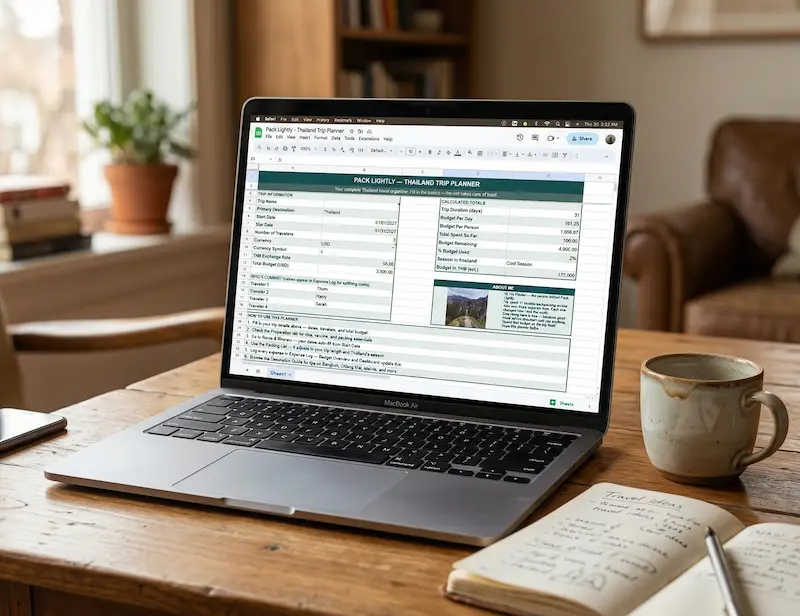
Plan your Sweden trip
A free Google Sheets template: itinerary planning, daily expenses, budget tracking and a packing list, with a dashboard that updates as you go.
Get the Free TemplateWhat Sweden costs per day
Per person per day in USD, drawn from the Pack Lightly budget calculator. Accommodation and food lead, and drinks and dining out push the total up fast.
Sweden, month by month
Stockholm: temperature (°F) and rainfall (inches). The south stays milder and the far north far colder, but the short summer window holds nationwide.
What if…
Sweden by trip length
Real day-by-day itineraries, one for each trip length. Pick the time you have and open the full plan.
Experience the vibrant city life of Stockholm, where the sun glints off the water and the air buzzes with energy. Transition to Gothenburg’s coastal charm, where fresh seafood markets and quaint neighborhoods invite leisurely exploration.
From the sunlit archipelago of Stockholm to the snowy expanses of Lapland, this journey contrasts vibrant city life with serene wilderness.
See the full day-by-day planFrom the vibrant streets of Stockholm to the serene wilderness of Lapland, this 21-day journey immerses you in Sweden’s diverse landscapes and cultures.
See the full day-by-day planBook your Sweden trip
Everything to sort before departure, at the same price as booking direct. It helps keep these guides free.
Before you commit
Why Sweden works
It runs on two seasons, not one. Summer brings midnight-sun daylight, warm lakes and the archipelago; winter turns Lapland into an aurora, snow and husky playground. Pick one and lean into it.
Getting around is painless. Trains and buses are punctual and comfortable, English is spoken everywhere, and card and phone payments work down to the smallest kiosk. Cash is nearly extinct.
Honest downsides
- It is expensive. Restaurant meals and alcohol in particular run high, so self-catering and the state Systembolaget stretch a budget
- Winter darkness is real. December gives Stockholm around six hours of daylight and the far north almost none
- Distances are long. Stockholm to Kiruna is close to a thousand miles, so fly or take the night train rather than drive it in a day
- Summer books out. July is the Swedish holiday month, so reserve Gotland, the archipelago and Lapland lodges well ahead
Sweden with kids
An easy trip with children. Playgrounds are everywhere, museums like Stockholm’s Vasa and Junibacken are built for families, and the archipelago ferries feel like an adventure in themselves.
Summer suits kids best, with long light evenings and swimmable lakes. In winter, husky rides and snow play in Lapland turn the cold into the whole point, as long as you pack the layers.
Frequently asked questions
Do US citizens need a visa for Sweden?
No visa for tourism. US citizens can stay in Sweden and the wider Schengen Area for up to 90 days within any 180-day period. The ETIAS travel authorization, a quick online pre-approval, is expected to become mandatory at some point during 2026, so check before you fly.
How much does Sweden cost per day?
Budget around $65 per person per day backpacking, with hostels, self-catering and supermarket lunches. Mid-range is closer to $155 with hotels and restaurant dinners; comfort travel runs $340 and up. Sweden sits among the pricier countries in Europe, with alcohol and dining out the sharpest costs.
When is the best time to visit Sweden?
June to August is the prime window, with long daylight, mild days and the archipelago at its best. For the northern lights, come between late September and March and head north to Lapland. Winter elsewhere is cold, dark and quiet.
Is Sweden safe for travelers?
Yes. Sweden is one of the safer countries in Europe, with a safety score of 90 in this guide. Violent crime against tourists is rare. The main issues are petty theft and pickpocketing in the busy parts of Stockholm, so keep an eye on bags in crowds and on transit.
How many days do you need in Sweden?
Ten days covers Stockholm, the archipelago and a southern city like Gothenburg or Malmo at a comfortable pace. Two weeks reaches Lapland and the Arctic north for the aurora or summer hiking. A focused winter aurora trip can work in five or six days.
Can you see the northern lights in Sweden?
Yes, in the far north. Abisko and Kiruna in Swedish Lapland are among the most reliable places on Earth to catch the aurora, with the clearest odds from late September to late March on dark, cloud-free nights. Abisko’s rain-shadow sky gives it an edge over the rest.
Photo credits: Photo: Øyvind Holmstad / Wikimedia Commons, CC BY-SA 4.0 · Photo: Tommie Hansen / Wikimedia Commons, CC BY 3.0 · Photo: tsaiproject from Canada / Wikimedia Commons, CC BY 2.0 · Photo: W. Bulach / Wikimedia Commons, CC BY-SA 4.0 · Photo: Ad Meskens / Wikimedia Commons, CC BY-SA 4.0 · Photo: Julian Herzog (Website) / Wikimedia Commons, CC BY 4.0 · Photo: Bengt Nyman from Vaxholm, Sweden / Wikimedia Commons, CC BY 2.0 · Photo: Arild Vågen / Wikimedia Commons, CC BY-SA 4.0 · Photo: L.G.foto / Wikimedia Commons, CC BY-SA 4.0 · Photo: Holger.Ellgaard / Wikimedia Commons, CC BY-SA 3.0