



United States
A continent pretending to be one country: red-rock deserts, glacier-carved parks, neon strips and a skyline that defined the modern city. The US rewards travelers who pick one region and drive it deep, rather than sprinting coast to coast.
The US is too big to see in one trip, so don’t try. Pick one region, rent a car, and let the distances shrink to something you can actually enjoy.
Pack Lightly editorial team
At a glance
- Nature and infrastructure both score 95: the national parks are world-class and the roads, flights and rentals that reach them are the best anywhere.
- Budget around $90 a day backpacking, $200 mid-range. This is one of the pricier trips on the planet, and cities like New York and Las Vegas push it higher.
- Late spring and fall are the sweet spots. Summer packs the parks and bakes the desert Southwest; winter shuts high-country roads but opens ski season.
- Two weeks is enough for one coast or one loop. The Southwest parks, the Northeast cities, or a single mega-park like Yellowstone each fill a trip on their own.
- The catch: there is no national rail worth planning around and distances are brutal. Budget for a rental car or internal flights, and never assume two dots on the map are a day trip apart.
Everything to know before you book
The essentials for a US trip: entry rules, money, the climate window and power, in one scan.
What the US does best, and where it doesn’t
Ten categories scored 0 to 100 from tourism data, traveler reports and on-the-ground experience.
The scenery competes with anywhere on earth, and the parks, highways and rentals that reach it are seamless. This is a country built for the road trip.
Value is the weak spot. Lodging, park gateways and city dining run high, tipping adds 15 to 20 percent, and the distances mean gas or airfare on top.
Best places to visit in the United States
Twelve destinations that anchor most first trips. Filter by region to plan your route.
Grand Canyon
A mile-deep gorge that photos never prepare you for. Watch it at sunrise from the South Rim, then hike below the edge to feel the scale.Las Vegas
Casinos, shows and buffets in the desert, plus the best base for Southwest road trips to Zion, the Grand Canyon and Death Valley.New York City
Museums, Broadway, skyline views and neighborhoods that each feel like their own city. The one US stop that runs on the subway, not a car.Yellowstone
Geysers, hot springs and more wildlife per mile than anywhere in the lower 48. Old Faithful is the headline; the Lamar Valley is the reason to stay.Grand Teton National Park
Granite peaks rise dramatically over the Jackson Hole valley, drawing hikers and wildlife watchers.Glacier National Park
Lake McDonald mirrors the surrounding peaks near trailheads into Glacier’s high country.Great Smoky Mountains National Park
Morning mist rolls over Cades Cove while black bears forage along the valley floor.Washington Dc
Cherry blossoms line the Tidal Basin each spring near the National Mall’s monuments.Charleston
Pastel rowhouses and antebellum plantations mark this South Carolina port city’s historic district.Key West
Street performers gather at Mallory Square each evening as the sky over the harbor turns color.Honolulu
Oahu’s capital pairs Waikiki Beach with a population of around 350,000 and centuries of Hawaiian history.Denver
Union Station anchors downtown Denver, the main gateway to Colorado’s Rocky Mountain trailheads.Southwest & Canyon Country
Rockies & Mountain West
West Coast & Pacific
Hawaii
Northeast, Mid-Atlantic & Great Lakes
South & Southeast
Florida
More places
The United States at a glance
Click a pin to open that destination guide.


All United States guides
Every Pack Lightly guide for planning, preparing and exploring the country.
Planning & Logistics
Practical & Preparation
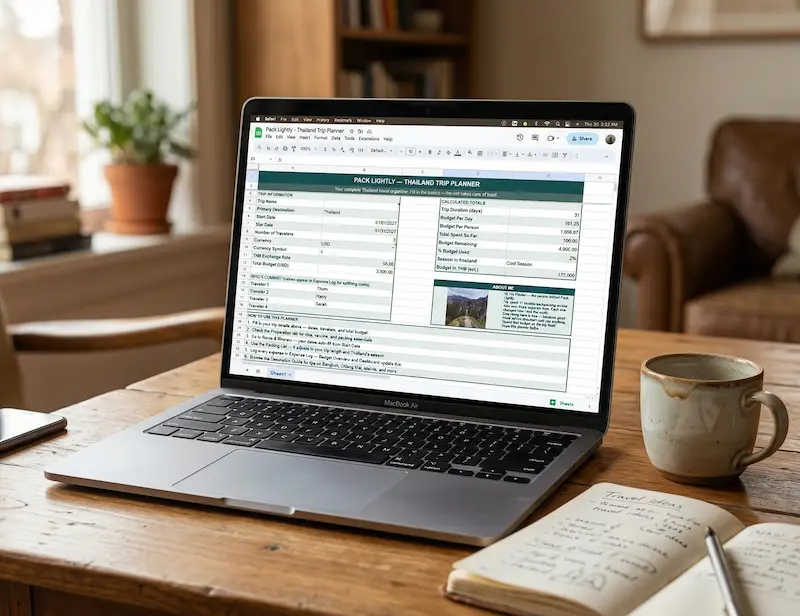
Plan your United States trip
A free Google Sheets template: itinerary planning, daily expenses, budget tracking and a packing list, with a dashboard that updates as you go.
Get the Free TemplateWhat the United States costs per day
Per person per day in USD, drawn from the Pack Lightly budget calculator. Accommodation and food lead, and the big cities run higher.
United States, month by month
New York City temperature (°F) and rainfall (inches). Averaged from 2021-2023 records.
What if…
United States by trip length
Real day-by-day itineraries, one for each trip length. Pick the time you have and open the full plan.
Experience the vibrant nightlife of Las Vegas, where neon lights pulse against the desert backdrop. Transition to the awe-inspiring vistas of the Grand Canyon, where the sun paints the canyon walls in hues of orange and red.
Experience the vibrant lights and nightlife of Las Vegas before transitioning to the serene landscapes of Zion National Park.
See the full day-by-day planExperience the stark contrasts of the Southwest, from the neon lights of Las Vegas to the serene beaches of Santa Barbara. Over three weeks, immerse in the vibrant nightlife, rugged hikes, and breathtaking landscapes that define this journey.
Start in the bustling streets of New York, where the energy is palpable, and transition to the serene landscapes of Seattle, where the air is fresh and crisp.
Book your United States trip
Everything to sort before departure, at the same price as booking direct. It helps keep these guides free.
Before you commit
Why the US works
It is fifty states doing their own thing under one flag. The desert Southwest, the New England coast, the Rockies and the Deep South eat, sound and look nothing alike, and the interstate system plus cheap domestic flights let you string several together.
The national parks are the crown jewel. Sixty-three of them protect landscapes you cannot see anywhere else, and the ranger programs, trails and lodges are set up for visitors who have never camped a day in their life.
Honest downsides
- It is expensive. Lodging near parks and in big cities runs high, and there is no cheap workaround in peak season
- Tipping is not optional. Budget 15 to 20 percent on restaurants, bars and rides on top of the listed price
- Distances lie on a map. Two parks that look close can be a full day’s drive apart
- Healthcare is costly. Travel insurance is essential, since an ER visit without it can run into thousands
The US with kids
Few places are easier with children. The parks run junior-ranger programs, cities are stacked with world-class museums and zoos, and portions, playgrounds and family rooms are the norm rather than the exception.
Drive times are the thing to watch. Break long transfers with roadside diners and viewpoints, and lean on the motel-pool-and-early-dinner rhythm that road-tripping families here swear by.
Frequently asked questions
Do foreign visitors need a visa for the United States?
It depends on your passport. Citizens of the 40-plus Visa Waiver Program countries can visit for up to 90 days with an approved ESTA, applied for online before departure. Everyone else needs a B-2 visitor visa arranged at a US embassy or consulate, which takes time, so start early.
How much does a US trip cost per day?
Budget around $90 per person per day backpacking, with hostels, self-catering and cheap eats. Mid-range is closer to $200 with hotels, restaurants and a rental car; comfort travel runs $500 and up. New York and Las Vegas cost more, and tipping adds 15 to 20 percent on service.
When is the best time to visit the United States?
Late spring (April to June) and fall (September and October) are ideal, with mild weather and open roads. Summer is peak for the parks but hot and crowded, and the desert Southwest bakes. Winter closes high-country roads but opens ski season across the Rockies and Sierra.
Is the United States safe for travelers?
Generally yes, with a safety score of 70 in this guide, a notch below Western Europe. Most trips pass without incident. The main things to plan for are petty theft in tourist areas, the cost of any medical emergency, and checking local advice for specific city neighborhoods after dark.
How many days do you need in the United States?
Ten days covers one region at a comfortable pace, such as a Southwest parks loop or the Northeast cities. Two weeks lets you pair a coast with a park via a domestic flight. Three weeks or more is the minimum to see two very different parts without rushing.
Do you need a car to travel the United States?
For most trips, yes. Outside a handful of big cities, public transit is thin and the national parks are effectively unreachable without a vehicle. New York City is the clear exception, running entirely on its subway. Elsewhere, plan on a rental car or internal flights between regions.
Photo credits: Photo: Domenico Convertini / Wikimedia Commons, CC BY-SA 2.0 · Photo: Thomas Wolf, www.foto-tw.de / Wikimedia Commons, CC BY-SA 3.0 · Photo: Frank Schulenburg / Wikimedia Commons, CC BY-SA 4.0 · Photo: Lennart Sikkema / Wikimedia Commons, CC BY 3.0 · Photo: Mariordo (Mario Roberto Durán Ortiz) / Wikimedia Commons, CC BY-SA 4.0 · Photo: Dllu / Wikimedia Commons, CC BY-SA 4.0 · Photo: Grastel / Wikimedia Commons, CC BY-SA 4.0