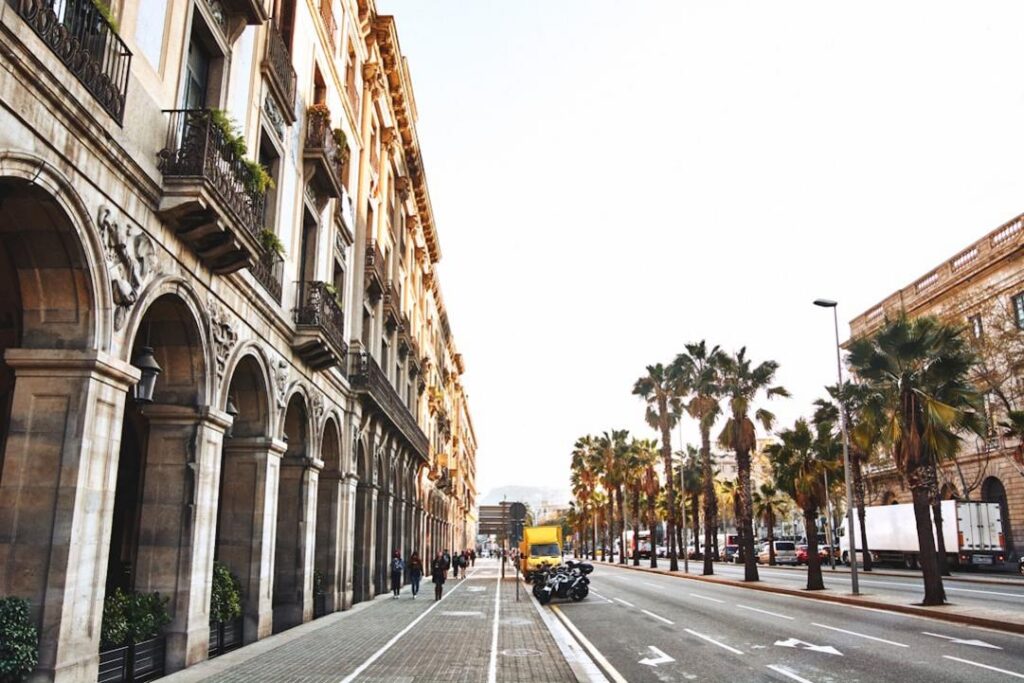
Spanish for travellers: essential words and phrases for Spain
June 23, 202610 min read
Spanish is the everyday language in Spain, written in the Latin alphabet, so signs and menus are at least decipherable, and English works in cities and tourist areas but thins out beyond them; Catalan, Basque and Galician also appear as co-official languages in their regions.
Getting by with English is possible in major cities and popular sites, but beyond these, a handful of Spanish words and a translation app are essential to navigate local interactions and show respect to residents.
Learn one key phrase: ‘Gracias’ for thank you, and ‘Por favor’ for please.
Use translation apps for complex questions or when unsure.
English is common in tourist hotspots but rare in rural areas.
Signs and menus are mostly in Spanish, with regional languages in their areas.
A few basic words open doors and earn goodwill with locals.
Quick Facts about Language in Spain
Official language(s): Spanish (Castilian).
Regional languages: Catalan, Basque, Galician.
English level: High in tourist hubs, limited in countryside.
Readability: Signs and menus mostly in Latin script, regional languages also appear.
In major cities and tourist hotspots, many young people and service workers speak at least basic English. You can usually get by with simple phrases, especially in hotels, restaurants, and shops in Madrid, Barcelona, Seville, and Valencia. However, in rural areas, small towns, and local markets, English drops sharply, and locals often rely on gestures or basic Spanish. Older generations tend to have limited English skills, so don’t assume fluency outside the tourist zones.
Decision Rules for Using English
If you are in a rural village or local market, then assume little English and prepare to point or use translation apps.
If you are in a major city or tourist hub, then expect some English but carry basic phrases for safety and courtesy.
If you are in a high-end restaurant or hotel, then English is likely understood; still, learn a few polite phrases in Spanish.
Signs, Menus, and Street Names
Most signs and menus in Spain are in Spanish, written in the Latin alphabet. In tourist areas, you will find bilingual signs or menus with English translations, especially in restaurants, museums, and transport hubs. Street names are usually only in Spanish, but some major streets in big cities may have bilingual signs. Use your phone’s translation app to decipher unfamiliar words or street names that aren’t bilingual.
Communication Tips for Travelers
Carry a translation app and learn a few key phrases like ‘hello’, ‘thank you’, and ‘help’ to bridge language gaps.
Use non-verbal signals like pointing, nodding, or miming to clarify your needs when language fails.
Be polite and patient; locals appreciate effort and good manners more than perfect pronunciation.
Speak slowly and clearly if using English, avoiding slang or complex sentences.
Show respect by addressing people with formal titles like ‘Señor’ or ‘Señora’ when appropriate.
Use gestures to indicate directions or quantities when ordering or asking for help.
Pay attention to facial expressions and body language to gauge understanding or discomfort.
If unsure, ask if they speak English before launching into a long explanation.
Frequently Asked Questions
1How big is the gap between younger and older people in English skills?
Younger Spaniards, especially in cities, are more likely to speak some English, but older generations often have limited or no English skills. Don’t rely on older locals for language help.
2Are body language or gestures understood differently locally?
Yes. For example, a thumbs-up is positive in Spain, but be cautious with hand gestures like the ‘OK’ sign, which can have different meanings. Observe locals and mirror their gestures to avoid misunderstandings.
3Do I need offline translation apps in rural areas?
Absolutely. Rural areas often lack reliable internet, so download offline Spanish language packs and maps beforehand. Pointing and gestures become even more important where digital help is unavailable.
4What is the social etiquette for addressing someone in the street?
Use formal greetings like ‘Buenos días’ or ‘Hola’ and address people with ‘Señor’ or ‘Señora’ unless invited to do otherwise. Respect personal space and avoid overly familiar gestures early on.
5How do I understand public transport tickets and destinations?
Look for bilingual signs at stations. Use your translation app to understand ticket machines and destination boards. When in doubt, ask station staff with a simple ‘¿Habla inglés?’
6What is a local word or greeting that instantly builds rapport?
Saying ‘Hola’ with a smile and a nod is universally friendly. Adding ‘Por favor’ and ‘Gracias’ shows politeness and respect, opening doors to better interactions.
Scroll to Top
Cookies on Pack Lightly
Cookies help us see which guides and tools travelers actually use, so we can make them better. We run no ads and never sell your data. You decide what we may use. Read our cookie policy
Your cookie preferences
Necessary cookies keep the site working and are always on. Turn the rest on or off, then save. You can change this anytime.
Always on
These keep Pack Lightly working: they remember your cookie choice and route you to the right page. The site cannot run properly without them, so they need no consent.
These help us see which tools and guides travelers actually use, so we can improve them. We use Google Analytics 4 and Microsoft Clarity. No advertising, no selling of your data.
We do not run ad banners on Pack Lightly. When you click a partner link for a hotel, flight, or activity, the partner may set a cookie so we receive credit for the referral, at no extra cost to you. Turn this off to opt out.
Strictly necessary1
pl_cookie_consent
Provider
Pack Lightly
Purpose
Stores your cookie choices so we do not ask again on every visit.
Retention
12 months
Type
HTTP cookie
Analytics4
_ga
Provider
Google Analytics
Purpose
Distinguishes one visitor from another to measure site usage.
Retention
2 years
Type
HTTP cookie
_ga_*
Provider
Google Analytics
Purpose
Keeps the state of your visit (session) for GA4 measurement.
Retention
2 years
Type
HTTP cookie
_clck
Provider
Microsoft Clarity
Purpose
Keeps a Clarity user ID so repeat visits are recognized for aggregate analytics.
Retention
1 year
Type
HTTP cookie
_clsk
Provider
Microsoft Clarity
Purpose
Connects the pages you view within one session.
Retention
1 day
Type
HTTP cookie
Marketing1
Affiliate referral cookies
Provider
Travelpayouts, Amazon, GetYourGuide and similar partners
Purpose
Set on the partner's own site when you click an outbound link, to attribute a referral. We set no advertising cookies on Pack Lightly itself.
Retention
Varies by partner (often up to 30 days)
Type
Third-party HTTP cookie
Pack Lightly is a travel planning platform. Our own analytics are first-party and hold no personal details. For the full picture, read the documents below. To change or withdraw consent later, open Cookie settings from the button at the bottom of any page.