



Tunisia
Roman amphitheatres, blue-and-white clifftop villages and Sahara dunes, packed into a country you can cross in a day. Tunisia gives you North Africa at its most approachable, at prices that still feel like a discovery.
Tunisia earns a spot on any Mediterranean shortlist. Give it ten days, pair the coast with one push into the desert, and let the Roman ruins set the pace.
Pack Lightly editorial team
At a glance
- Culture, history and value all score 80. This is one of the best-priced trips in this guide, with world-class ruins to match.
- Budget around $35 a day backpacking, $75 mid-range. Food, transport and stays all run cheap by Mediterranean standards.
- Spring and fall bring warm, dry days without peak heat. July and August are beach season and genuinely hot inland.
- One to two weeks covers the north, the Roman sites and a taste of the Sahara without rushing.
- The catch: tourist infrastructure is thin outside the resort strips, so getting to the desert and inland ruins takes planning and patience.
Everything to know before you book
The essentials for a Tunisia trip: visa, money, climate window and power, in one scan.
What Tunisia is, and what it isn’t
Ten categories scored 0 – 100 from tourism data, traveler reports and on-the-ground experience.
History and value carry the trip. Roman ruins, medieval medinas and warm hospitality all land near the top, at prices that stay low.
The soft spot, and an honest one. Outside the coastal resorts, signage, transport and English support thin out fast. Build in extra time for the inland routes.
Best places to visit in Tunisia
Twelve anchor stops in the north that most first trips are built around.
Tunis
A UNESCO medina of covered souks and tiled courtyards, the mosaic-filled Bardo museum, and the ruins of ancient Carthage a short train ride out on the bay.Sidi Bou Said
A blue-and-white clifftop village above the Gulf of Tunis, all cobbled lanes, cafe terraces and mint tea with a sea view. The prettiest half day near the capital.Carthage
Byrsa Hill’s ruins overlook the Gulf of Tunis where the ancient Carthaginian civilization once stood.Dougga
A well-preserved Capitol temple anchors one of North Africa’s best-preserved Roman archaeological sites.Bulla Regia
Roman villas here were built partly underground, with mosaic floors still visible below street level.Tabarka
Pine-backed beaches meet the Needles rock formations along this coral-diving town near the Algerian border.Monastir
A ribat fortress overlooks the Mediterranean in this Sahel town of about 60,000 people.Djerba
Houmt Souk harbor cafes serve the day’s catch straight off fishing boats on this island off the southeast coast.Ksar Ghilane
Natural hot springs sit at this remote oasis on the edge of the Grand Erg Oriental dunes.Ksar Ouled Soltane
Multi-storey storage cells stack up at this fortified Berber granary near Tataouine.Tamerza
Rugged cliffs of the Mides canyon drop into a palm-filled oasis at Tunisia’s western edge.Chott el Djerid
Salt crusts stretch to the horizon and shift color from white to pink as the sun moves.Tunisia at a glance
Click a pin to open that destination guide.


All Tunisia guides
Every Pack Lightly guide for planning, preparing and exploring the country.
Planning & Logistics
Practical & Preparation
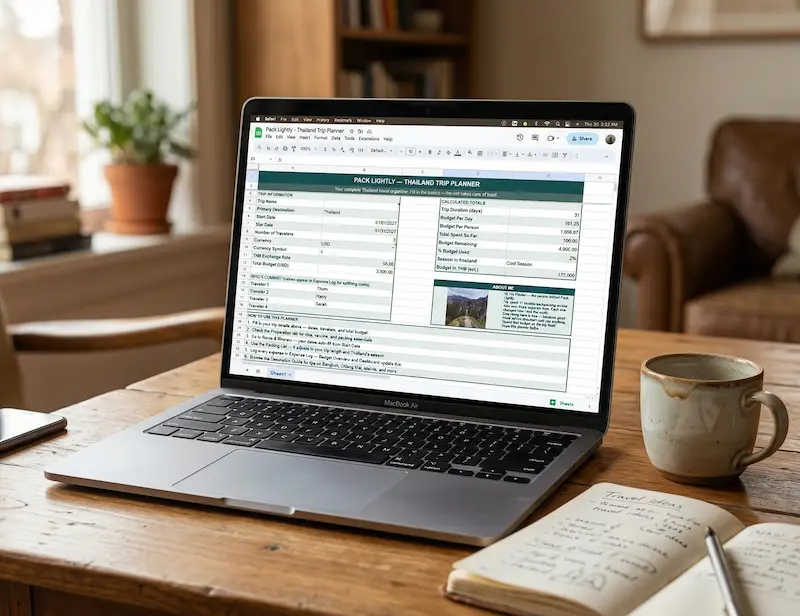
Plan your Tunisia trip
A free Google Sheets template: itinerary planning, daily expenses, budget tracking and a packing list, with a dashboard that updates as you go.
Get the Free TemplateWhat Tunisia costs per day
Per person per day in USD, drawn from the Pack Lightly budget calculator. Stays and food are the cheapest lines.
Tunisia, month by month
Tunis: temperature (°F) and rainfall (inches). Hot, dry summers and mild, wetter winters on the coast; the Sahara south runs hotter and drier still.
What if…
Tunisia by trip length
Real day-by-day itineraries, one for each trip length. Pick the time you have and open the full plan.
Tunis buzzes with the vibrant energy of its medina, where the scent of spices fills the air and street vendors beckon with local delicacies.
See the full day-by-day planExperience the vibrant chaos of Tunis medina, where the air is filled with spices and the streets buzz with life.
See the full day-by-day planBook your Tunisia trip
Everything to sort before departure, same price as booking direct, and it helps keep these guides free.
Before you commit
Why Tunisia works
It stacks an unusual amount into a small country. Roman ruins, a UNESCO medina, Sahara dunes and warm Mediterranean beaches all sit within a day’s drive of each other, at prices well below southern Europe.
It is also one of the more relaxed entry points to North Africa. Visa-free access for US citizens, French widely spoken, and a coast used to visitors make the first days easy.
Honest downsides
- Thin infrastructure inland: signage, transport and English support drop off fast once you leave the resort strips
- Summer heat: July and August push past 90°F / 32°C and the desert south runs hotter still
- Getting around takes patience: shared louage vans and slow trains work but reward planning ahead
- Check current advisories: remote border zones near Algeria and Libya are best avoided; the tourist regions are calm
Tunisia with kids
The coast makes it easy. Hammamet and Djerba are built around family resorts with shallow, calm water, and short transfer times keep travel days manageable.
Older kids get a lot out of the Star Wars sets near Tozeur, a camel ride at the edge of the Sahara, and clambering through the El Djem amphitheatre. Keep desert days short and carry plenty of water.
Frequently asked questions
Do US citizens need a visa for Tunisia?
No. US passport holders can enter Tunisia visa-free for tourism and stay up to 90 days. Your passport should be valid for at least six months beyond your arrival date. You get an entry stamp on landing, so no advance paperwork is needed.
How much does Tunisia cost per day?
Budget around $35 per person per day backpacking, using guesthouses, street food and shared transport. Mid-range is closer to $75 with comfortable hotels and restaurant meals; comfort travel runs about $160. Tunisia is one of the cheapest destinations in this guide.
What’s the best time to visit Tunisia?
April to June and September to October bring warm, dry days without peak heat, ideal for combining the coast, ruins and desert. July and August are hot beach season, busy on the coast and very hot inland. Winter is mild and wetter but fine for cities and Roman sites.
Is Tunisia safe for tourists?
The main tourist regions, including Tunis, the northern coast, Kairouan and the desert gateways, are calm and used to visitors. Standard city precautions against pickpocketing apply. Remote border areas near Algeria and Libya are best avoided, so check your government’s current advisory before travel.
How long do you need in Tunisia?
Five days covers Tunis, Carthage, Sidi Bou Said and a Roman site or two. One week adds a beach base in the north. Ten days to two weeks lets you reach the Sahara around Tozeur and Douz and still enjoy the coast without rushing.
Can you visit the Sahara from Tunisia?
Yes, and it is one of the highlights. The desert gateways of Tozeur and Douz sit in the southwest, roughly a long day’s drive from Tunis. From there you can join dune camps, camel treks, oasis visits and the salt flats of the Chott el Djerid. Give the south at least two days.
Photo credits: Photo: MAREK SZAREJKO from CLONMEL, IRELAND - POLAND / Wikimedia Commons, CC BY-SA 2.0 · Photo: McKay Savage from London, UK / Wikimedia Commons, CC BY 2.0 · Photo: Kais photographies / Wikimedia Commons, CC BY-SA 4.0 · Photo: Rawen Ab / Wikimedia Commons, CC BY-SA 4.0 · Photo: Noomen9 / Wikimedia Commons, CC BY-SA 4.0 · Photo: IssamBarhoumi / Wikimedia Commons, CC BY-SA 3.0 · Photo: Mohamed Moslem Mosbah / Wikimedia Commons, CC BY-SA 3.0