


The right pair depends on three things: compression level in mmHg, graduated (not uniform) compression, and an exact fit from a sizing chart. For flights, 15-20 mmHg graduated knee-highs are the standard travel choice; go higher only on a doctor’s advice, and always size by calf circumference and shoe size, never by S/M/L guesswork.
Two pairs of compression socks can look identical on a shelf and do completely different jobs on a 9-hour flight. One is graduated, sized to your calf, and rated correctly for your trip. The other is a tube sock with a marketing label. Here is what actually separates a correct pair from a wrong one, before you add anything to the cart.
Do Compression Socks Actually Help With DVT Risk on Flights
The evidence is real but narrower than most product pages imply. The CDC’s Yellow Book guidance recommends properly fitted below-the-knee graduated compression stockings, providing 15-30 mmHg of pressure at the ankle, specifically for long-distance travelers on trips over 6 hours who already have an increased risk of venous thromboembolism (VTE), alongside frequent ambulation and calf muscle exercise. For long-distance travelers who are not at increased VTE risk, the same guidance does not recommend graduated compression stockings. Cochrane review evidence separately supports that 15-30 mmHg graduated compression stockings meaningfully reduce asymptomatic DVT on flights longer than four hours. The NHS notes DVT risk rises on any journey of 4 hours or more by plane, car, or train, but its own advice for that scenario centers on loose clothing, hydration, avoiding alcohol, and moving around, not compression stockings. The full risk-factor breakdown and evidence debate live in a companion piece: do compression socks work for flying. This guide assumes you have already decided to buy a pair and covers what makes one correct.
What the mmHg Number on the Label Actually Means
mmHg stands for millimeters of mercury, the same pressure unit used to report blood pressure. On a compression garment, it measures how firmly the fabric squeezes the leg: a higher number means a tighter, stronger squeeze. Retail compression hosiery is sold in four common bands, and the number on the packaging tells you which one you are holding before you even try it on.

| Band | Common label | Typical use |
|---|---|---|
| 8-15 mmHg | Mild | Light everyday support, not the default travel band. |
| 15-20 mmHg | Moderate, “travel socks” | The band most travel-labeled socks are sold at by default. |
| 20-30 mmHg | Firm, medical-grade | Generally a clinical recommendation, not a self-selected upgrade. |
| 30-40 mmHg | Extra-firm, prescription-grade | Prescribed for specific medical conditions. |
Most socks marketed as “flight socks” or “travel compression socks” default to the 15-20 mmHg band. That is not an accident: it is the band the general travel-comfort recommendation points to, and it is comfortable enough for a full day of wear. Confirm the number on the box, though, rather than trusting the word “travel” printed on the packaging; the label vocabulary is not standardized the way the mmHg number is.
Graduated vs Uniform: the Design That Matters for Flights
Graduated compression is tightest at the ankle and gradually loosens moving up the calf. That gradient works with the direction blood needs to travel: against gravity, back up toward the heart, during the hours you spend sitting still on a flight. Uniform (or flat) compression applies the same pressure the entire length of the sock. It is not the design used in medical or travel-specific compression garments, and it does not create the pressure gradient the graduated design relies on.
Key takeaways
- Graduated: tightest at the ankle, progressively looser toward the knee. This is the travel-relevant design.
- Uniform: same pressure throughout. Not the design used in compression hosiery built for travel or medical use.
- Virtually every reputable travel compression sock is graduated by default, but confirm it on the listing before buying rather than assuming.

It is a genuinely rare gap on a modern listing, since the compression hosiery industry has largely standardized on graduated construction for anything marketed at travelers. Still, “graduated” is a spec to verify on the product page, the same way you would check mmHg, rather than an assumption to skip past.
Compression Level: Which mmHg Is Right for Your Flight
15-20 mmHg is the general travel-comfort standard sold for flights, and it is the right default for most buyers picking their own pair. The CDC’s higher guidance, 15-30 mmHg for trips over 6 hours, applies specifically to travelers who already have elevated VTE risk factors. That is a doctor conversation, not a self-selected upgrade: the CDC guidance itself does not extend the recommendation to travelers without those risk factors.
Buy at standard travel-grade
- No known risk factors: 15-20 mmHg graduated knee-highs cover general travel comfort.
- Comfort-focused shoppers: the 15-20 mmHg band is designed for a full day of wear.
Talk to a doctor first
- 20 mmHg and above: generally something to buy on clinical advice, not a self-directed upgrade.
- Personal or family clot history, recent surgery, pregnancy, or a circulation condition: get a doctor’s recommendation before choosing anything above standard travel-grade.
The pattern holds across the whole buying decision: reach for firmer compression only when a clinician has told you to, not because a higher mmHg number sounds like more protection. On the shelf, 15-20 mmHg is the answer for the vast majority of flight-comfort buyers.
Put the right pair on the list before you pack
Build a trip-specific packing list by destination and flight length, with flight-comfort gear like compression socks built in.
Sizing and Fit: Why the Size on the Box Beats the Brand Name
Compression socks work by applying a precise pressure gradient, and that gradient only exists at the size it was engineered for. A size too loose delivers materially less pressure than the mmHg printed on the packaging, no matter how reputable the brand. A size too tight does the opposite of the intended job: instead of aiding circulation, it can restrict it, causing numbness, deep skin indentation, or pain.
- Measure calf circumference: the widest point of the calf, checked against the specific brand’s sizing chart, not a generic small/medium/large label.
- Check shoe size too: most brand charts combine calf measurement with shoe size to land on the correct fit.
- Never guess by S/M/L alone: compression sizing is brand-specific, so a medium in one brand is not interchangeable with a medium in another.
- Try a new pair on before travel day: discovering a fit problem at home costs an exchange; discovering it on the plane costs the flight.
Correct sizing is the buying-decision variable that gets skipped most often, because it takes an extra minute with a tape measure instead of a click on a size label. That minute is the difference between a pair that does its job at altitude and one that either does nothing or actively causes discomfort.
When Compression Socks Matter Most: Flight Duration
Flight length changes how much a correct pair matters, and it is a reasonable factor in how much buying-decision effort to spend.
| Flight length | Priority | What matters |
|---|---|---|
| Under 4 hours | Lowest | A comfort-only purchase decision; fit still matters if you buy, but urgency is low. |
| 4-6 hours | Moderate | The window where the general travel-comfort recommendation (15-20 mmHg graduated) applies. |
| 6 hours and up | Highest | The trips CDC’s at-risk-traveler guidance specifically addresses; a correctly fitted graduated pair matters most here. |
The 6-hour line is not arbitrary. It is the same threshold CDC’s Yellow Book guidance uses for long-distance travel, and it lines up with where the Cochrane review evidence on graduated compression and asymptomatic DVT applies. A short domestic hop is a low-stakes buying decision either way; a long-haul flight is where getting the mmHg, the graduated design, and the size right actually changes what the sock does for you.
Putting Them On: Before the Flight, Not During
One practical note belongs in a buying guide, because it affects which pair to choose. Compression socks are engineered to fit and apply their pressure gradient correctly on a normal, non-swollen leg. That means the buying decision should assume you put them on before boarding, not partway through the flight once the legs you are trying to help have already started to swell. Factor that into sizing too: measure and fit the sock to your normal calf, not to how your leg feels after hour six in the air.
FAQ
01What mmHg compression socks should I buy for a flight?
15-20 mmHg graduated knee-highs are the standard travel choice for most flights. Higher levels (20 mmHg and up) are generally a doctor’s recommendation rather than a self-selected upgrade, particularly relevant for long-haul travelers with elevated clot risk.
02Is graduated compression better than regular compression socks for flying?
Yes. Graduated compression is tightest at the ankle and gradually loosens up the leg, which supports blood flow back toward the heart during long periods of sitting. Uniform compression applies the same pressure throughout and is not the design generally used for travel or medical compression garments.
03How do I know what size compression socks to buy?
Measure calf circumference and shoe size against the specific brand’s sizing chart, not a generic S/M/L label. A size that is too loose provides little real compression regardless of the mmHg printed on it; a size that is too tight can cause numbness or skin indentation rather than help.
04Do I need compression socks for a short flight?
Compression socks matter most on longer flights. Health guidance on elevated clot-risk travelers centers on trips over roughly 6 hours; for shorter flights, fit and comfort matter more than reaching for a higher compression level.
05Can compression socks be too tight?
Yes. Too-tight compression socks can restrict circulation and cause numbness, deep skin indentation, or pain, rather than helping blood flow. Correct sizing by calf measurement, not just pulling on the tightest pair available, is the buying-decision fix.
06Do compression socks actually prevent blood clots on flights?
The evidence-backed guidance applies specifically to travelers with elevated clot-risk factors on longer trips, where graduated compression stockings around 15-30 mmHg are recommended alongside movement. For travelers without those risk factors, health guidance does not recommend compression stockings as a prevention measure.
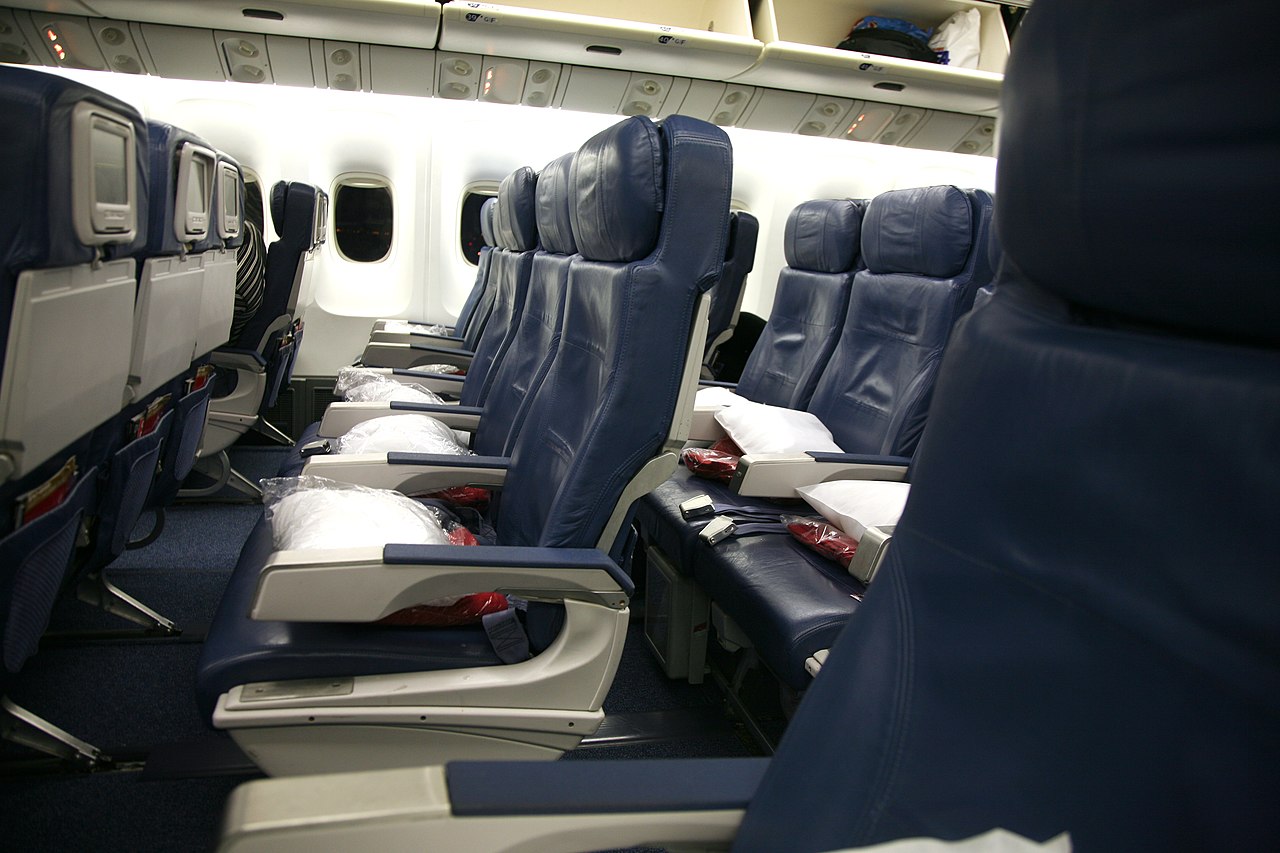
Image credits: economy class cabin by Vincent Desjardins / Wikimedia Commons (CC BY 2.0); sphygmomanometer by ML5 / Wikimedia Commons (public domain); knee-high and thigh-high compression stockings by Lentpjuve / Wikimedia Commons (CC BY-SA 4.0).


