


The humpback is the whale you are most likely to actually see. It hugs the coast on its migration, it breaches and slaps and waves a flipper at the boat, and it shows up on nearly every populated coastline on earth at some point in the year. The only real question is timing. Humpbacks live on a fixed annual schedule, feeding in cold high-latitude water through the local summer and breeding in warm tropical water through the local winter, so the right month near you is rarely more than a few months away. Match the season to the coast and a sighting is close to a sure thing.
Why timing is everything
Humpbacks make one of the longest migrations of any mammal, up to roughly 8,000 km each way between two very different jobs. In summer they crowd the cold, food-rich waters near the poles, gorging on krill and small fish to build the fat they will live on for months. As autumn closes that larder down, they swim toward the equator to calve and breed in warm shallow tropics where newborns can survive without a blubber layer. They eat almost nothing during this breeding stretch, then turn around and head back to the feeding grounds.
That single rhythm explains the entire map. To see feeding humpbacks you want high latitudes in their summer: Alaska, Iceland, Norway in the north; Antarctic-edge waters off Chile and the deep south in the southern summer. To see breeding humpbacks, mothers, calves and singing males, you want the tropics in the local winter: Hawaii, the Dominican Republic, Tonga. Because the northern and southern hemispheres run opposite calendars, there is a humpback season somewhere almost every month of the year. The mistake people make is travelling to a feeding ground in the breeding season, or the reverse, and finding empty water.

North America: Hawaii, Alaska, California, New England
For anyone travelling within or from the United States, the realistic winter option is Hawaii. Thousands of North Pacific humpbacks leave Alaska each autumn and gather in the warm, shallow channels around Maui, Lanai and Molokai to breed, with the Hawaiian Islands Humpback Whale National Marine Sanctuary protecting the core of it. The season runs December to April and peaks in January and February, when the water off Lahaina can hold so many whales that breaches are almost constant. You can watch from a boat, from a kayak, or simply from a clifftop with a coffee.
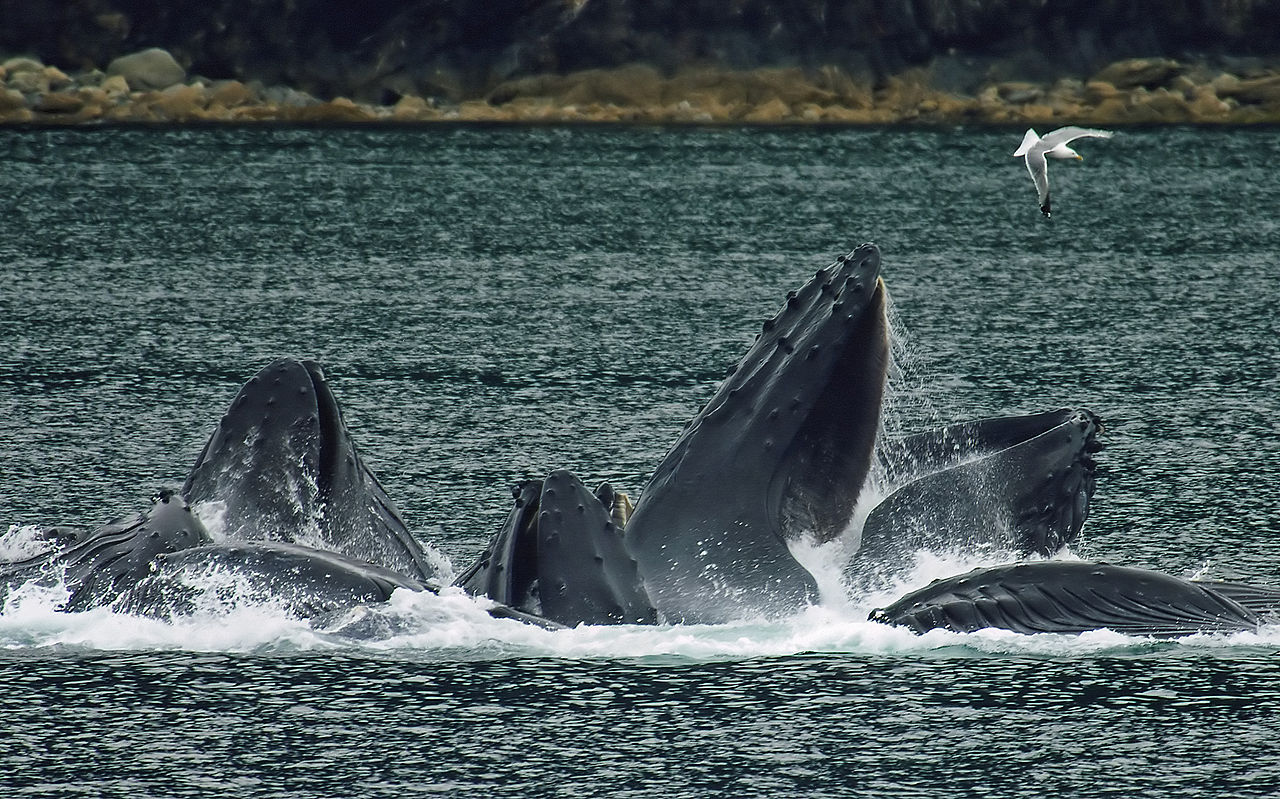
The other side of the same population is the Alaska feeding season. From June through September humpbacks pack into the cold channels of Southeast Alaska, and Glacier Bay National Park is one of the best places on earth to watch them bubble-net feed, a cooperative tactic where a group blows a curtain of bubbles to corral fish, then lunges up through the middle together with mouths open. It is the most spectacular feeding behaviour the species performs, and it does not happen in the tropics.
Down the West Coast, central California sees humpbacks feeding offshore through summer and autumn, with day trips out of Monterey Bay reliable from roughly May to October. On the Atlantic side, New England’s Stellwagen Bank off Cape Cod is the classic East Coast ground, busy from April into October when humpbacks feed on sand lance close enough to Boston for a half-day boat. The pattern holds: the continental USA gives you feeding whales in summer and Hawaii gives you breeding whales in winter, so there is no month of the year without an option somewhere under the flag.
See the humpback season for any country, month by month
The Animals Around the World map plots every country where humpbacks appear, the parks and bays to watch from, and how good your odds are in each month, alongside more than 1,900 other species. It is the fastest way to line up a trip you already have with a coast where the whales will actually be there.
Australia and the South Pacific
Australia runs the southern-hemisphere version of the same story, and on a huge scale. Tens of thousands of humpbacks travel up both coasts on the so-called Humpback Highway, heading north from Antarctic feeding waters to warm breeding grounds and back, roughly May to November. On the east coast the whales pass Sydney, Byron Bay and Hervey Bay, with Hervey Bay famous for relaxed, curious whales that linger near boats on the southward return leg from August. On the west coast they stream past Exmouth and Ningaloo Reef from June into October, where you can sometimes swim with them under licence. June to August is the surge north, September to November the slower trip south with new calves.

The Pacific island groups sit on the breeding end of that same southern migration, and they offer the one thing most coasts cannot: legal in-water encounters. Tonga, and the Vavaʻu archipelago in particular, is the world’s best-known place to swim with humpbacks, from July to October when mothers and calves rest in the sheltered channels. Strictly regulated, small groups, and about as close as the species allows. French Polynesia, around Rurutu and Moorea, and the Cook Islands, Fiji, New Caledonia and Samoa all run the same July-to-October South Pacific breeding window. If you want to be in the water with a humpback rather than above it, this is the corner of the map to aim for.
The Caribbean and the Silver Bank
The North Atlantic population breeds in the Caribbean from January to April, and the single biggest gathering is in the Dominican Republic. Samaná Bay fills with mating and calving humpbacks in February and March, watched from boats out of Samaná town, and the offshore Silver Bank sanctuary is one of only a handful of places on earth that permits in-water encounters with breeding humpbacks. From whale-watching guides clustered around Samaná’s whale-watching boats, the season is short and intense: late January to late March is the heart of it.
The rest of the eastern Caribbean catches the same northbound migration a little later, roughly January through April, as whales filter up the island chain. Turks and Caicos sits right on the Silver Bank passage, and the Lesser Antilles, Guadeloupe, Martinique, Saint Vincent and the Grenadines, Barbados, see passing humpbacks on day boats in the same months. None match Samaná for sheer numbers, but they put a humpback season within reach of a winter beach holiday.

For Caribbean trips the booking matters as much as the timing. A reputable operator stays back, lets the whale choose the approach, and never chases or boxes in a mother and calf. The Dominican Republic option is bookable through Samaná Bay whale-watching trips, which run only during the January-to-April season.
Iceland, Norway and the African coasts
Europe’s humpbacks are feeders, so the season is the northern summer. Iceland is the easy headline: Húsavík on Skjálfandi Bay calls itself the whale-watching capital of Europe, and from May to September boats there deliver near-certain sightings of humpbacks feeding alongside minke whales and white-beaked dolphins, often only a few hundred metres from the boat. Faxaflói Bay near Reykjavík runs the same summer season for travellers short on time. The Azores in Portugal catch passing humpbacks from April to September, directed in real time by clifftop spotters.

Northern Norway flips the usual calendar. Around Tromsø and Skjervøy, humpbacks and orca follow huge herring shoals into the fjords in late autumn and early winter, so the prime window is roughly November to January, in polar twilight that can pair whales with the northern lights overhead. It is cold, dark and unlike any other humpback trip on the list.
The southern-hemisphere winter, June to November, lights up the African coasts on the breeding migration. Humpbacks calve off Mozambique’s Bazaruto coast from July to November, pass Réunion from July to October where boats out of Saint-Gilles see mothers and calves close in, and gather off Gabon’s Loango coast from June to September, one of the few places the same coastline puts whales and forest elephants within a day of each other. Whichever hemisphere you are in, the rule repeats: feeding whales in the cold-water summer, breeding whales in the tropical winter.
Best months by region
The single most useful thing to know before booking is which hemisphere and which job you are aiming for. This grid is the short version, and the table under it pairs each headline coast with its window.
| Region | Best months | What you see | Headline spot |
|---|---|---|---|
| Hawaii, USA | December to April | Breeding, calves, breaching | Maui (Lahaina) |
| Alaska, USA | June to September | Bubble-net feeding | Glacier Bay |
| New England, USA | April to October | Feeding offshore | Stellwagen Bank |
| Australia (both coasts) | May to November | Migration, mothers and calves | Hervey Bay, Ningaloo |
| Tonga and South Pacific | July to October | Breeding, legal swim-with | Vavaʻu |
| Dominican Republic | January to April | Breeding, in-water on Silver Bank | Samaná Bay |
| Iceland | May to September | Summer feeding | Húsavík |
| Norway | November to January | Feeding on herring, with orca | Skjervøy, Tromsø |
| Mozambique and Réunion | July to October | Breeding migration | Bazaruto, Saint-Gilles |
The takeaway is simple. There is a humpback season on almost every coast on earth, so the smart move is not to chase a single famous spot but to pick by where you already are or already want to go, then travel in that hemisphere’s right months. Want feeding whales and a cold-water summer? Aim north in June to September, or far south in the southern summer. Want breeding whales, calves and warm water? Aim for the tropics in the local winter: Hawaii or the Caribbean in January and February, the South Pacific in August and September. Get the hemisphere and the season right and the humpback does the rest.

Common questions
01Where is the best place to see humpback whales?
It depends on the season. For breeding whales and calves in warm water, Hawaii from December to April and Samaná Bay in the Dominican Republic from January to April are the densest gatherings. For feeding whales, Glacier Bay in Alaska from June to September and Húsavík in Iceland from May to September are hard to beat. For swimming with humpbacks, Tonga’s Vavaʻu islands from July to October.
02Where can I see humpback whales in the United States?
Hawaii is the winter option, with thousands of humpbacks breeding off Maui from December to April. In summer, Alaska’s Glacier Bay offers bubble-net feeding from June to September, central California has whales off Monterey from May to October, and New England’s Stellwagen Bank off Cape Cod runs April to October.
03What month is best for humpback whale watching?
There is no single best month worldwide, because the hemispheres run opposite seasons. January and February are peak in Hawaii and the Caribbean, July to September are peak in Alaska, Tonga and Australia, and November to January are best in northern Norway. Pick the coast first, then the month.
04Where can you swim with humpback whales?
Legal in-water encounters are rare and tightly regulated. Tonga, especially the Vavaʻu archipelago, is the best known, from July to October. The Silver Bank sanctuary off the Dominican Republic permits it in February and March, and parts of Australia’s Ningaloo Reef allow licensed swim-with trips from June to October.
05Why do humpback whales migrate so far?
They feed in cold, food-rich waters near the poles during the local summer, building fat reserves, then swim toward the tropics to breed and calve in warm shallow water during the local winter, where newborns survive without a blubber layer. The round trip can exceed 16,000 km, one of the longest migrations of any mammal.
06Can you see humpback whales in Europe?
Yes. Iceland is the most reliable, with summer feeding off Húsavík and Faxaflói Bay from May to September. The Azores in Portugal catch passing humpbacks from April to September, and northern Norway sees them follow herring into the fjords from November to January, sometimes alongside orca and the northern lights.
Image credits, all via Wikimedia Commons: breaching humpback (Ballena Marine National Park) Giles Laurent (CC BY-SA 4.0); tail fluke Whit Welles (CC BY-SA 3.0); bubble-net feeding Evadb (Public domain); underwater pectoral fins Whit Welles (Public domain); whale and whale-watching boat Ryan Hodnett (CC BY-SA 4.0); Faxaflói Bay, Iceland Jakub Hałun (CC BY-SA 4.0); breach splash Giles Laurent (CC BY-SA 4.0).


